Chapter 17 - The Strategic Harness
Loop Engineering by Fabio Correa, the Applied AI foundation volume on working with AI through framing, feedback, verification, memory, and human judgment.
Last updated 2026-10-25. New in the second edition, Chapter 17 opens Part V, The Harness in Practice. This page carries the chapter's working tool, the Harness Canvas, the pages it connects to, and the announcement of the Harness Assessment. The chapter composes every harness on two surfaces at once: deterministic controls and semantic capabilities.
The question this chapter takes up
How do you compose the whole architecture into one governed system an organization can put its name on, and how would you know whether a real tool measures up to it?
Put it to work: the Harness Canvas
The Canvas is the chapter's one-page design worksheet: ten fields to complete before a harness runs. Fill it in plain language, on a single page, before the work starts. Download the Canvas (SVG), or print this page and write on it.
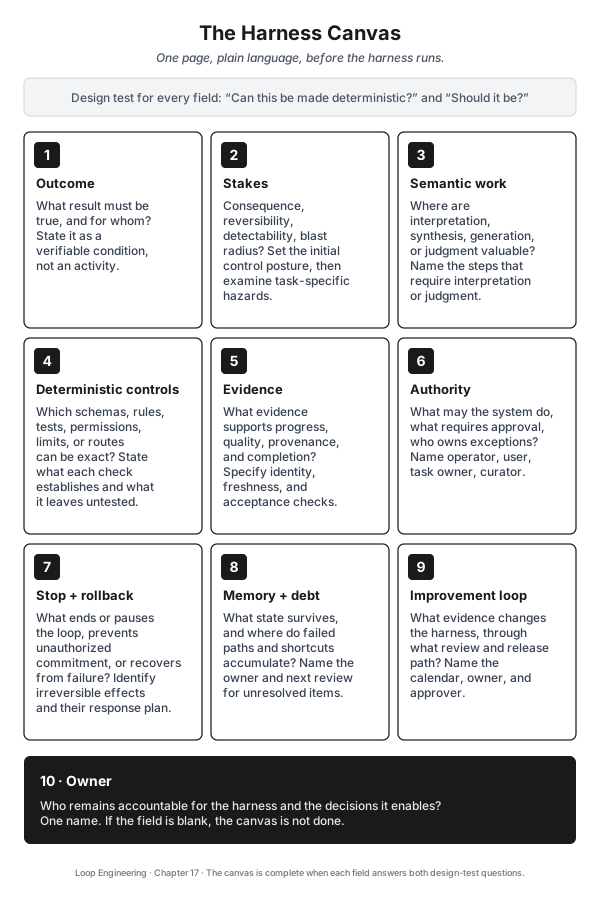
- Outcome — What result must be true, and for whom? State it as a verifiable condition, not an activity.
- Stakes — Consequence, reversibility, detectability, blast radius? Set the initial control posture, then examine task-specific hazards.
- Semantic work — Where are interpretation, synthesis, generation, or judgment valuable? Name the steps that require interpretation or judgment.
- Deterministic controls — Which schemas, rules, tests, permissions, limits, or routes can be exact? State what each check establishes and what it leaves untested.
- Evidence — What evidence supports progress, quality, provenance, and completion? Specify identity, freshness, and acceptance checks.
- Authority — What may the system do, what requires approval, who owns exceptions? Name the operator, the user, the task owner, the curator.
- Stop + rollback — What ends or pauses the loop, prevents unauthorized commitment, or recovers from failure? Identify irreversible effects and their response plan.
- Memory + debt — What state survives, and where do failed paths and shortcuts accumulate? Name the owner and next review for unresolved items.
- Improvement loop — What evidence can change the harness, through what review and release path? Name the calendar, the owner, and the approver of changes.
- Owner — Who remains accountable for the harness and the decisions it enables? One name. If the field is blank, the canvas is not done.
One design test applies to every field: can this be made deterministic, and should it be? The canvas is complete when each field answers both questions, not just the first.
Where this chapter connects
- The Materiality Dial — composition starts from the stakes; the dial is how the stakes get classified (Chapter 13).
- Responsible AI — the obligations of Chapter 16 are promises of the kind a harness exists to keep.
Coming: the Harness Assessment
The book describes the harness. This site will measure real tools against the description. The Harness Assessment is an empirical, black-box evaluation: scripted probes administered to an AI tool exactly as a user experiences it, scored against the ten Canvas fields above, with the full traces published so any reader can check the verdicts.
- Probe scripts are frozen and published before a tool is run; each probe runs three times, because these systems are stochastic.
- Each field earns one verdict: Demonstrated, Partial, Not observed, or Not determinable from outside. There is no aggregate score; a single number would claim a precision the method cannot support.
- Everything scored is observable behavior. The test reverse-engineers from the operator's seat and says so: its claims are bounded, in the spirit of Chapter 19.
- The first subject is Muse. The method is published on the Harness Assessment page; results and traces will be published there as runs complete.
Status: in preparation. The method is published on the Harness Assessment page; results will be posted there as the first runs complete.